
Budget + Finance
What belongs in a custom home budget?
By Jonathan Cortez · Edge Crew Custom Homes
Updated September 15, 2026
Earlier Edge Crew coverage: May 9, 2017
Budget for the whole project—not just the house.
A custom home budget should account for the entire project: the property, design and engineering, site preparation, the home itself, selections, outdoor work, builder compensation and financing-related expenses. The useful number is the total for the home you actually intend to build, with a clear explanation of what is included and what remains outside the scope.
That distinction matters. A house price can look comfortable until a long driveway, utility extension or substantial retaining wall appears in a separate conversation. Those pieces still belong to the investment, even when they sit outside the building contract.
Start with a complete scope
We recommend organizing the discussion around five groups:
- Property and preparation: land purchase, surveys, evaluations, clearing, access, utilities and drainage.
- Design and documentation: plans, engineering, specifications and applicable approvals.
- Construction: foundation, framing, roofing, windows, exterior work, plumbing, electrical, heating and cooling, insulation and finishes.
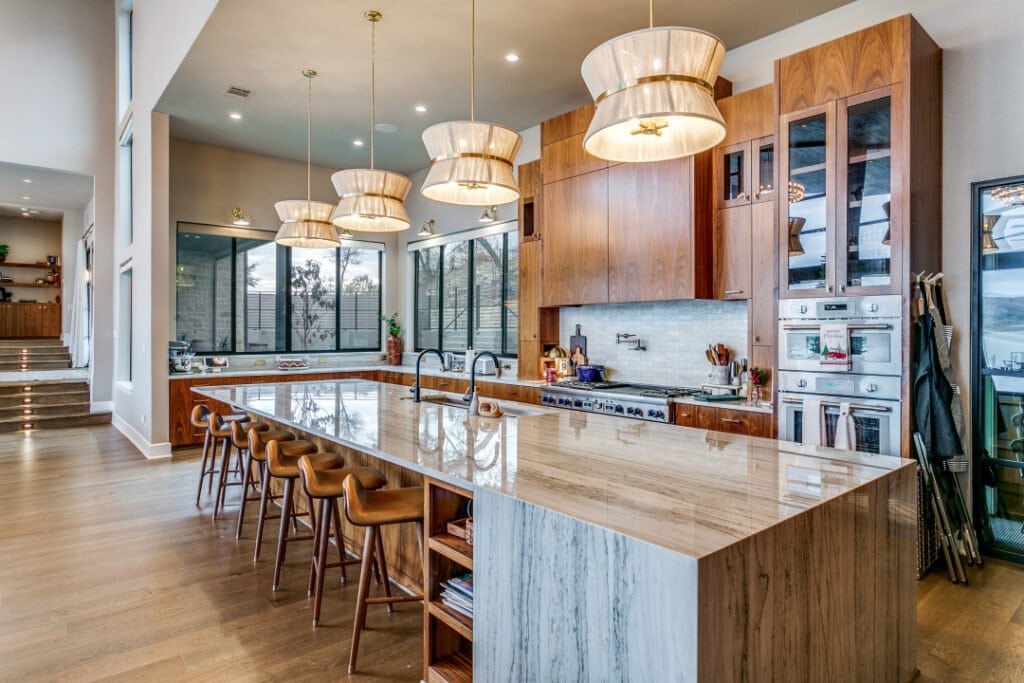
- Selections and outdoor living: cabinetry, counters, fixtures, appliances, patios, landscape and any separate structures included in the plan.
- Project and ownership costs: builder compensation, financing expenses, insurance and a clearly identified provision for unresolved conditions.
Not every item is purchased through the builder. The point is to identify who carries each cost before assuming the budget is complete.
A budget changes as decisions become specific
An early concept gives us a direction. A developed plan, specifications and actual selections give us something much more useful to price. A kitchen described as “nice” leaves a wide range of possibilities. A kitchen with an agreed cabinet layout, appliance package and finish schedule narrows that range.
Our design process brings plans, selections and budgeting forward together. Waiting until the architecture is finished to discuss the investment can leave you choosing between redesigning the home and spending beyond your original intention.
Separate uncertainty from an upgrade wish list
A contingency is a provision for uncertainty. It should not quietly become the source of money for every new feature. If you decide to add an outdoor kitchen, identify its full scope and price separately so the remaining provision still means something.
Ask which parts of the estimate are supported by defined scope and current pricing, which are allowances, and which remain unresolved. One total without those distinctions can create false confidence.
Before accepting a number
Ask for a written list of inclusions, exclusions and assumptions. Then ask: “What else will I need to pay for to reach the finished home we are discussing?” That question is often more useful than comparing two headline prices.
For the next step, bring your property information, priorities and overall investment comfort level to a conversation with us. You do not need a finished plan to begin aligning the home with the budget.
01 / Scope
What is included, excluded and still assumed?
02 / Responsibility
Who pays for each cost outside the building contract?
03 / Uncertainty
Which figures are allowances or unresolved estimates?
Jonathan Cortez is a third-generation builder at Edge Crew Custom Homes, based in Bridgeport, Texas. Our work brings design, selections, budgeting and construction together for custom homes in North Texas. Meet our family.